“Children shouldn't have to think about survival”: 1,000 days of war in the West Bank
July 9, 2026
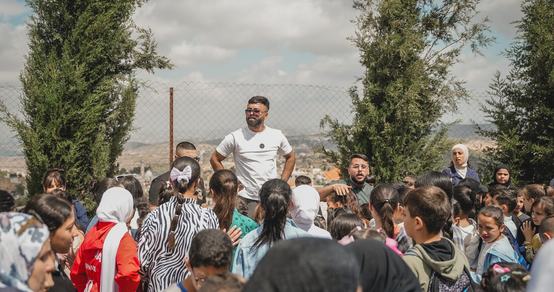
While the world has watched Gaza, children in the West Bank have lived through more than 1,000 days of military raids, settler violence, arrests and forced displacement, without any pause.
This is what that does to a child.
The violence you don't see
“We have witnessed an unprecedented escalation in the levels of violence and insecurity experienced by children and their families,” says Samia, a staff member from War Child’s partner organisation in the West Bank*. “We work with children every day who have been subjected to repeated raids, forced displacement, the loss of family members, arrests and ongoing closures that have affected their ability to access education and essential services.”
War Child and our partners in the West Bank witness the impact this has on children, and work alongside families to help them cope, rebuild their confidence and reclaim moments of childhood. Yet children still face an uphill battle.
“Many people only see the figures and the news reports,” explains Rola, another partner staff member. “But they do not realise the extent of the daily psychological impact on children. Fear, anxiety and uncertainty have become part of their lives.”
For children in the West Bank, uncertainty has unfortunately become normality. A road closure can prevent them from getting to school. An Israeli military raid can interrupt their sleep. Forced displacement means families routinely lose their income or are forced to leave their homes.
As Mariam from another of our partners explains, “Palestinian children grow up in an environment where their lives can change at any moment due to a road closure, a raid, the arrest of a family member, or the loss of the family's source of income. This chronic stress affects children's psychological and social development, as well as their ability to learn, plan for the future and build healthy, secure relationships.”
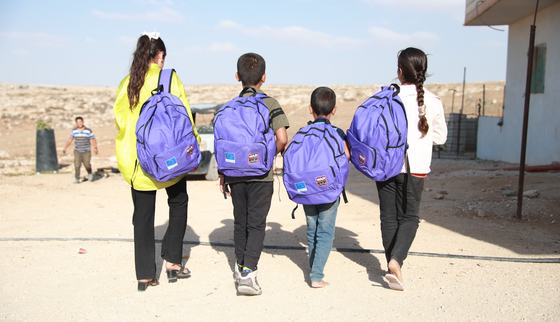
Children in the West Bank experience high levels of stress and protection risks. Through Team Up, War Child provides safe spaces for children to play, process and find reprieve.
Losing more than a home
Samia works directly with displaced families and describes the emotional impact on children as impossible to forget.
“I have seen children wake up to the sounds of raids and explosions and leave their homes in a hurry without even being able to take their toys or personal belongings with them,” she says.
“I met children whose eyes were filled with questions beyond their years: Where will we live? Will we return to our home? Why has all this happened?”
Displacement doesn't end when families find somewhere else to stay. The loss of routine, interrupted education, financial hardship and uncertainty continue to affect children's wellbeing long afterwards.
“The impact was not merely physical,” Samia explains. “It had a profound effect on children's mental health, with feelings of fear, sadness, confusion and a loss of security.”
As violence and restrictions continue, many children have begun speaking less about their dreams and more about their fears.
“What is most striking is that many children now talk more about fear and loss than they do about their dreams and ambitions.”
Manal, staff of another of our partners, puts it simply: “Spontaneity has been stolen from children.” Instead of exploring the world in safety, children in the West Bank are growing up surrounded by checkpoints, raids and uncertainty. Academic performances are declining as repeated disruptions to education leave lasting gaps in both learning and wellbeing.
Helping children reclaim their childhood
Children in crisis need more than food and shelter. They need somewhere they're able to feel safe again.
Through partners in the West Bank, War Child supports mental health and psychosocial support programmes, TeamUp sessions, recreational activities and theatre performances. All these activities provide children with safe spaces to play, express themselves and process what they are experiencing.
Ghada, from another partner, recalls watching children take part in games and theatre performances.
“It was painful to see children carrying burdens far greater than their years,” Ghada says. “But at the same time it was a source of hope to see their ability to engage and recover when given the right opportunity.
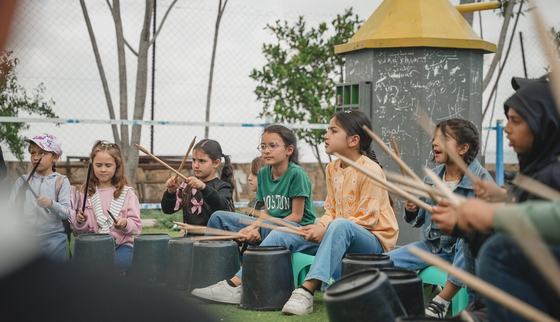
During an open day in the West Bank, children take part in creative activities.
“During the activities we ran in partnership with War Child, I watched children taking part in games and theatre performances, laughing freely. Those moments confirmed to me that psychosocial support is not a secondary intervention, but a fundamental need for children in times of crisis.”
Samia remembers a boy who was displaced after losing his home. Initially withdrawn and fearful, he gradually began taking part in psychosocial activities and returned to drawing.
“In one of the sessions, he drew the home he had lost and then drew a new house next to it, saying, When I grow up, I want to build a better house.””
Another young girl, who had become terrified of loud noises, slowly found the confidence to talk about her fears and begin interacting with her peers again.
“These small moments give us hope,” Samia says. “They confirm that children have a great capacity to recover when they are provided with the right protection and support.”
What children need now
Palestinian children have been systematically failed. Their rights under international law to protection, healthcare, food, water, shelter and education continue to be denied – not just by Israeli military and settler violence, but also by the government of Israel's illegal destruction of the systems and services they depend on to survive.
The psychological effects of prolonged violence do not disappear overnight. Children continue to carry the emotional impact of what they have experienced long after periods of reduced violence.
Recovery is possible. But only with an end to violence, occupation, and Israeli policies that stop children from living their lives fully.
“I hope that Palestinian children will enjoy a safer and more stable environment that allows them to learn and fulfil their dreams,” Rola shares. “The resilience and determination we see in these children give us hope for a better future.”
Mariam adds: “Today's children need more than just humanitarian aid; they need real opportunities to learn, grow, participate and realise their dreams.”
Every day, through our committed partners across the West Bank, War Child is helping children find moments of safety, joy and connection amid ongoing uncertainty.
None of this is inevitable. It's a choice, and so far, the world has chosen to look away.